

Most software projects that run late or end in dispute share one cause: the two sides never agreed in writing on what would be built. The client imagines one thing, and the developer understands another. A requirements document solves this before work begins.
What is a requirements document? #
A written file that describes the project in plain language: what the system will do, for whom, and how we know it is done. It does not need to be technical. It only needs both the project owner and the developer to understand it the same way.
The sections, step by step #
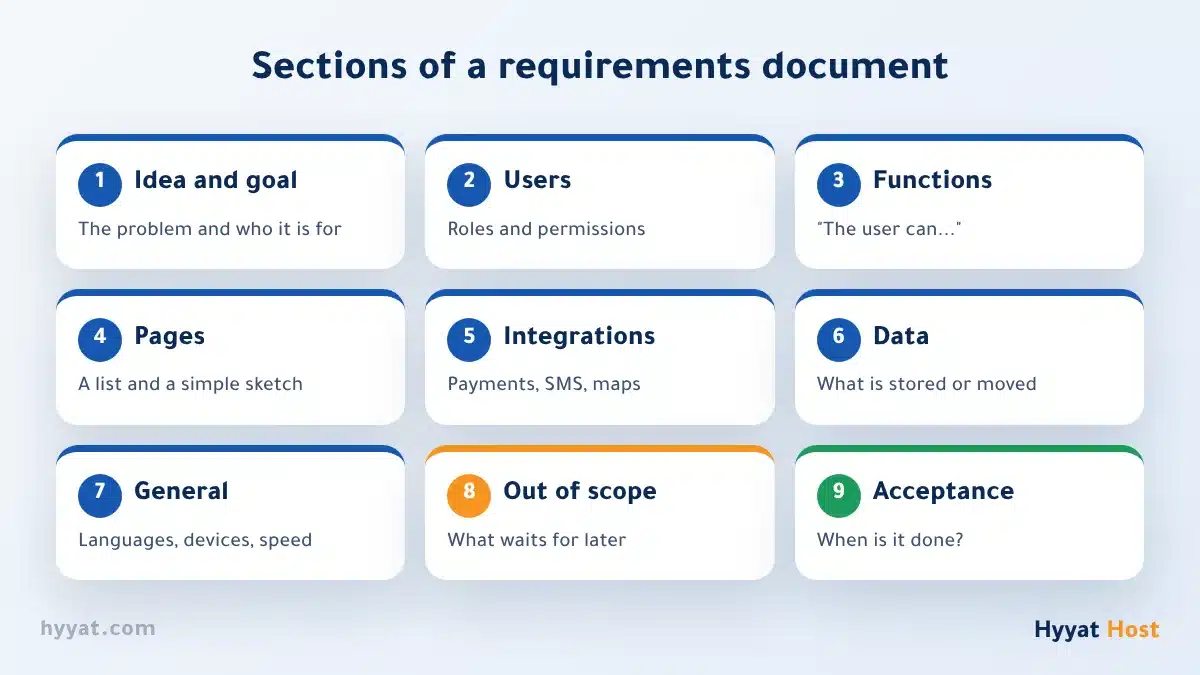
- Idea and goal: What problem does the project solve, and for whom? One paragraph.
- Users and permissions: Who will use the system? Visitor, registered customer, staff, admin. And what each one can see or do.
- Functions: Write each function as a sentence starting with “The user can…”, for example: “The customer can book an appointment and receive a confirmation message”.
- Pages or screens: A list of pages, even with a simple hand sketch of each.
- Integrations: Payment gateway, SMS, maps or an accounting system. The fees for these services are usually paid by the project owner.
- Data: What is stored? Is there old data to move from a previous system?
- General requirements: Languages, devices, required speed and security.
- Out of scope for now: State clearly what you are leaving for a later phase, so it is not taken as required.
- Acceptance criteria: When is each function considered done? For example: “The booking appears in the admin panel within a minute”.
A template you can copy #
Copy this template and fill in each item in simple words:
1. Project idea and goal
   - What problem does it solve, and for whom?
2. Users and permissions
   - Visitor, registered customer, admin...
3. Required functions (per user)
   - "The customer can..."
4. Pages or screens
5. Integrations
   - Payment gateway, SMS, maps...
6. Data
   - What is stored? What is imported from an old system?
7. General requirements
   - Languages, devices, speed, security
8. Out of scope for now
9. Acceptance criteria
   - When is each function considered done?
Common mistakes #
- Vague phrases like “a site like Amazon” or “a complete system”. Write the actual functions instead.
- Forgetting permissions: who can delete, edit or see reports?
- Forgetting life after delivery: who adds content, and who runs the system day to day?
- Adding new requests during the work without updating the document. A new request is priced and scheduled on its own.
How we handle requirements at Hyyat Host #
| Project size | Analysis phase |
|---|---|
| Small and clear | Free requirements analysis, and a fixed price for the whole project. |
| Medium or large | Starts with a paid analysis phase, after which you receive a requirements document that becomes yours. Its cost is fully deducted from the project if work starts within 60 days of delivery. |
The approved document is the reference at delivery: anything in it that does not work as written is fixed free, and anything not in it is a new request. Details in our design and programming terms.
Summary #
- A requirements document is the written agreement on what will be built.
- Write functions in clear sentences, and state what is out of scope.
- A clear document means a more accurate price, faster delivery and fewer disputes.
Have a project idea? See our custom programming service, and protect your idea first with a non-disclosure agreement.
Frequently asked questions #
Do I need technical experience to write a requirements document?
No. Write it in simple words; what matters is describing clearly what you want the system to do. We help you organize it.
What is the difference between a requirements document and a quote?
The document describes in detail what will be built, and the quote is based on it. Without a document, the price is only a rough estimate.
Is the analysis phase free?
For small, clear projects, yes. For medium and large projects it is paid, and fully deducted from the project if work starts within 60 days of receiving the document.
Who owns the requirements document?
It becomes yours after the analysis phase, even if you decide to build the project with someone else.
What if I want to add a function during the work?
It is treated as a new request, priced and scheduled before it is built, so the rest of the project is not delayed.
- How to Protect Your Project Idea Before Development: NDAs and Your Rights
- Who Owns the Source Code After Your Website Is Built? Ownership, Accounts and Handover
- WordPress or Custom Development? When Your Website Needs Each One
- What to Prepare Before Designing Your Company Website: Content, Images and Domain


