E-Invoicing for Online Stores in Saudi Arabia: What You Need to Do in 2026
Updated: 27 Nov 20265 min readCompany websites
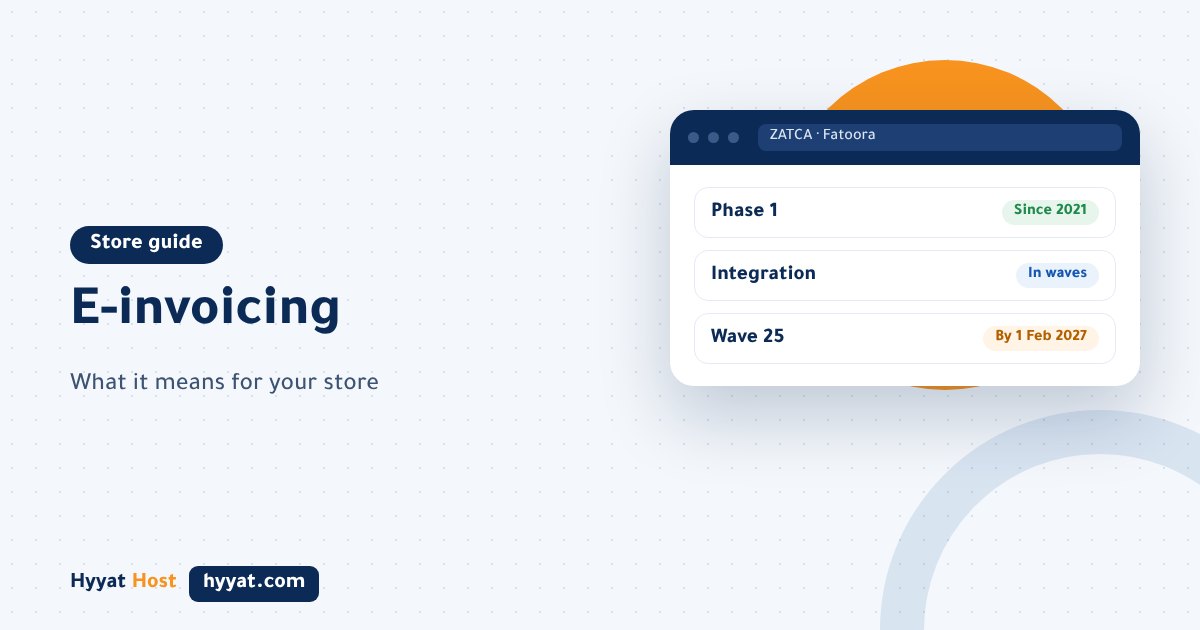
In short: E-invoicing is a ZATCA system that requires VAT-registered businesses to issue and store invoices electronically from a compliant solution, then integrate that solution with the Fatoora platform in waves. Wave 25 covers businesses whose VAT-able revenue exceeded SAR 187,500 in any year from 2022 to 2025, with integration due by 1 February 2027.
If you run an online store in Saudi Arabia and are registered for VAT, the invoice your customer receives after each order is no longer just a PDF from a store plugin. There are official requirements for its format, how it is issued and how it is stored, plus a second phase that connects your system directly to the authority.
This guide explains both phases in plain language, who the current wave covers, and what it means in practice for a WooCommerce store. To be clear from the start: this is a general explanation, not tax advice; the official reference is ZATCA’s website and your accountant.
Official reference: all e-invoicing details, wave lists and deadlines are on ZATCA’s e-invoicing page.
The two phases at a glance
Phase
Since
What is required
Phase 1: Generation
4 December 2021
No more handwritten invoices or ones made in text editors or spreadsheets
use a compliant solution that issues and stores invoices with the required fields, including a QR code
Phase 2: Integration
In waves since 2023
Connect your solution to ZATCA’s Fatoora platform and issue invoices in a specified format with additional fields
Phase 2 does not start for everyone on the same day. ZATCA defines each wave by a revenue criterion and notifies the businesses in it at least six months before their integration date.
Does the current wave cover your store?
ZATCA announced wave 25 with this criterion:
VAT-able revenue exceeded SAR 187,500 in any of 2022, 2023, 2024 or 2025.
Integration deadline: no later than 1 February 2027.
If you have not been notified and are unsure of your position, do not assume you are out of scope. Check your account on ZATCA’s portal and ask your accountant; Phase 1 still applies to every business under the regulation before its wave.
Invoice to a business or to an individual?
Most stores sell to individuals and some sell to businesses too, and the difference matters in Phase 2:
Type
For
What happens in Phase 2
Tax invoice
Businesses (B2B)
Cleared by the Fatoora platform before it is sent to the buyer
Simplified tax invoice
Individuals (most store orders)
Reported to the Fatoora platform within 24 hours of issue
So your system needs to know each invoice’s type: is the buyer an individual or a business with a VAT number? That usually means an optional VAT number field at checkout.
What this means for a WooCommerce store
An invoice plugin alone is not enough: PDF plugins that design a nice invoice do not make it compliant or connected to Fatoora.
The usual approach: a compliant accounting or point-of-sale system issues the official invoice, with a connector that sends store orders to it automatically, or a connector plugin linking WooCommerce to a compliant solution.
Ask the provider: is it Phase 2 compliant? Does it handle the Fatoora integration for your wave? Who is responsible for errors?
Test before the deadline: place test orders for an individual and a business, and check the QR code, fields and invoice numbering.
Storage and security: your site and hosting
E-invoicing means financial and customer data stored electronically, and that is where the platform your store runs on matters:
Regular backups of the store database plus an off-server copy, as in the 3-2-1 backup rule.
SSL on every store page, especially checkout and the customer account.
Limited permissions in WooCommerce: only those who need invoices and customer data can see them.
It applies to VAT-registered businesses. Phase 1 applies to all of them, and Phase 2 reaches each business in its wave according to the revenue criterion ZATCA announces.
What are wave 25’s criterion and deadline?
VAT-able revenue above SAR 187,500 in any year from 2022 to 2025, with integration with the Fatoora platform no later than 1 February 2027.
Is a PDF invoice plugin in WooCommerce enough?
Not necessarily. You need a compliant solution that issues the invoice with its fields and QR code and connects to Fatoora in Phase 2. Ask the provider to confirm compliance in writing.
Is this article tax advice?
No, it is a general explanation. The official reference is ZATCA’s website, and for decisions about your store consult your accountant or tax adviser.
H
The Hyyat Host team
These articles are written by the Hyyat Host hosting, domains and email team, managing customer servers and services since 2002. We review and update them when prices or services change.
We use necessary cookies to run the site, and Google Analytics to measure visits only if you agree. You can change your choice at any time from “Cookie settings”. Privacy policy