Saudi Personal Data Protection Law: What Does It Require From Website and Store Owners?
Updated: 25 Nov 20266 min readCompany websites
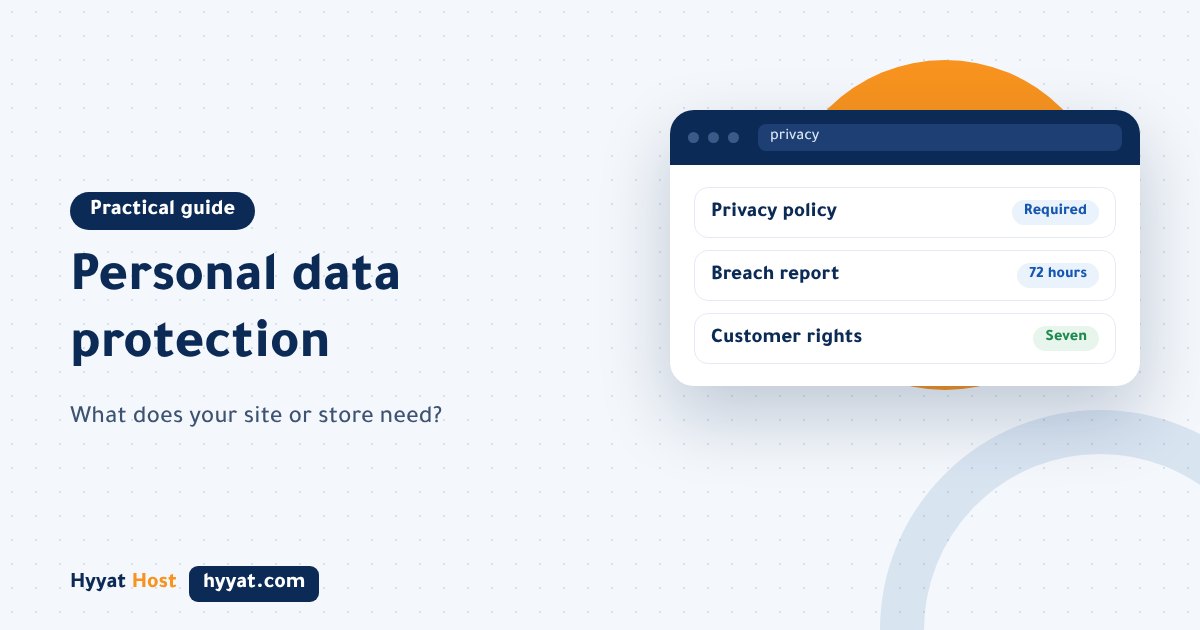
In short: The Personal Data Protection Law has been fully enforceable since 14 September 2024 and covers any site or store that collects data about people in Saudi Arabia. The essentials: a clear privacy policy, collecting only what you need, protecting data technically, reporting any breach within 72 hours, and respecting customers’ rights to access, correct and delete their data. This article is general guidance, not legal advice.
Every contact form on your site, every customer account in your store and every newsletter sign-up means you are collecting personal data: names, mobile numbers, addresses and emails. In Saudi Arabia this is governed by the Personal Data Protection Law (PDPL), overseen by the Saudi Data and AI Authority (SDAIA).
The law took effect on 14 September 2023 with a one-year grace period that ended on 14 September 2024. Here we turn its key points into practical steps for an ordinary site or store. Because legal details can change and depend on your business, check the official source or a lawyer before any decision.
Want your customers’ data kept inside the Kingdom?Saudi hosting keeps your site’s files and database on servers inside Saudi Arabia.
Does the law apply to your site?
Most likely, yes. It applies to any entity that processes personal data of individuals in the Kingdom, even if the entity is abroad. A contact form, customer registration or online orders are enough. Purely personal and family use is outside its scope.
What do you need to do in practice?
A clear privacy policy on your site stating what data you collect, why, on what basis, who you share it with, and how customers can contact you about it.
Collect only what you need: do not ask for an ID number or date of birth in a form that does not need it.
Consent: consent is one of the main bases for processing, and customers may withdraw it at any time. State the purpose when collecting data, and do not pre-tick a marketing consent box.
Protect the data technically: an SSL certificate, strong passwords, regular updates and limited access to your admin panel.
Delete what you no longer need once the purpose ends, or when the customer asks where that applies.
Your customers’ rights
Under the privacy policy guidelines issued with the law, your policy should explain the data subject’s rights, including:
The right to be informed how their data is collected and processed.
The right to access their data and get a copy.
The right to request correction.
The right to request destruction.
The right to withdraw consent at any time.
The right to file a complaint.
The right to claim compensation for damage.
Set up a clear way to receive these requests, such as a dedicated email or form, and decide who on your team handles them.
If there is a breach: 72 hours
If your customers’ data leaks, from a hack for example, the law requires notifying SDAIA within 72 hours of becoming aware, where notification is required, and notifying those affected without undue delay. So prepare in advance:
Who makes the call in your company.
How you will find out what leaked, which needs logs and backups.
The law does not ban transferring data abroad outright, but it sets conditions: transfers to countries with adequate protection, or under specific safeguards, keeping the data transferred to a minimum. Some sectors have extra requirements.
Hosting your site and database inside the Kingdom does not replace your other obligations, but it simplifies the cross-border question for your site’s own data. Remember data can leave by other routes too: your payment gateway, email marketing tool and analytics.
Penalties in brief
Under the law, general violations can be fined up to SAR 5 million, and disclosing or publishing sensitive data with intent to harm or for personal gain carries up to two years in prison and/or a fine of up to SAR 3 million. The point is not to scare you, but to take the basics seriously.
What goes in your privacy policy?
A generic template is not enough; the policy must describe what actually happens on your site. Include at least:
Your organisation’s name and how to contact you about data.
The data each form collects, and why.
The outside tools data passes through: payment gateway, courier, analytics and email service.
How long you keep data, or the criteria you use.
Data subjects’ rights and how to exercise them.
The date the policy was last updated.
Review the policy whenever you add a form or a new tool; the guidelines call for periodic review.
A quick checklist for this week
Review every form on your site and remove unnecessary fields.
Update your privacy policy to list the seven rights and how to contact you.
Make sure the marketing consent box is not pre-ticked.
Turn on SSL on every page and confirm it with the SSL checker.
Review who has access to your admin panel and remove old accounts.
Make sure you have backups and logs that will help if something happens.
Start from the right technical foundation.Saudi hosting keeps your site’s data inside the Kingdom with a free SSL certificate and backups, and we design sites and stores that collect only what they need through WordPress design.
When did the Personal Data Protection Law become mandatory?
It took effect on 14 September 2023, and the compliance grace period ended on 14 September 2024, making it fully enforceable.
Does it apply to a small store?
Yes. It applies to any entity that processes personal data of individuals in the Kingdom, whatever its size, except purely personal and family use.
What is the deadline for reporting a data breach?
Notify SDAIA within 72 hours of becoming aware, where notification is required, and notify those affected without undue delay.
Must my site be hosted inside Saudi Arabia?
The law does not require it for every site, but it sets conditions for transferring data abroad. Hosting inside the Kingdom simplifies this for your site’s data, and some sectors have their own requirements.
H
The Hyyat Host team
These articles are written by the Hyyat Host hosting, domains and email team, managing customer servers and services since 2002. We review and update them when prices or services change.
We use necessary cookies to run the site, and Google Analytics to measure visits only if you agree. You can change your choice at any time from “Cookie settings”. Privacy policy